
The 360° Social Commerce Playbook
A complete guide to building social commerce around an owned, on-site shopping experience — and using Instagram, TikTok, YouTube, and Pinterest to amplify it, not anchor it.
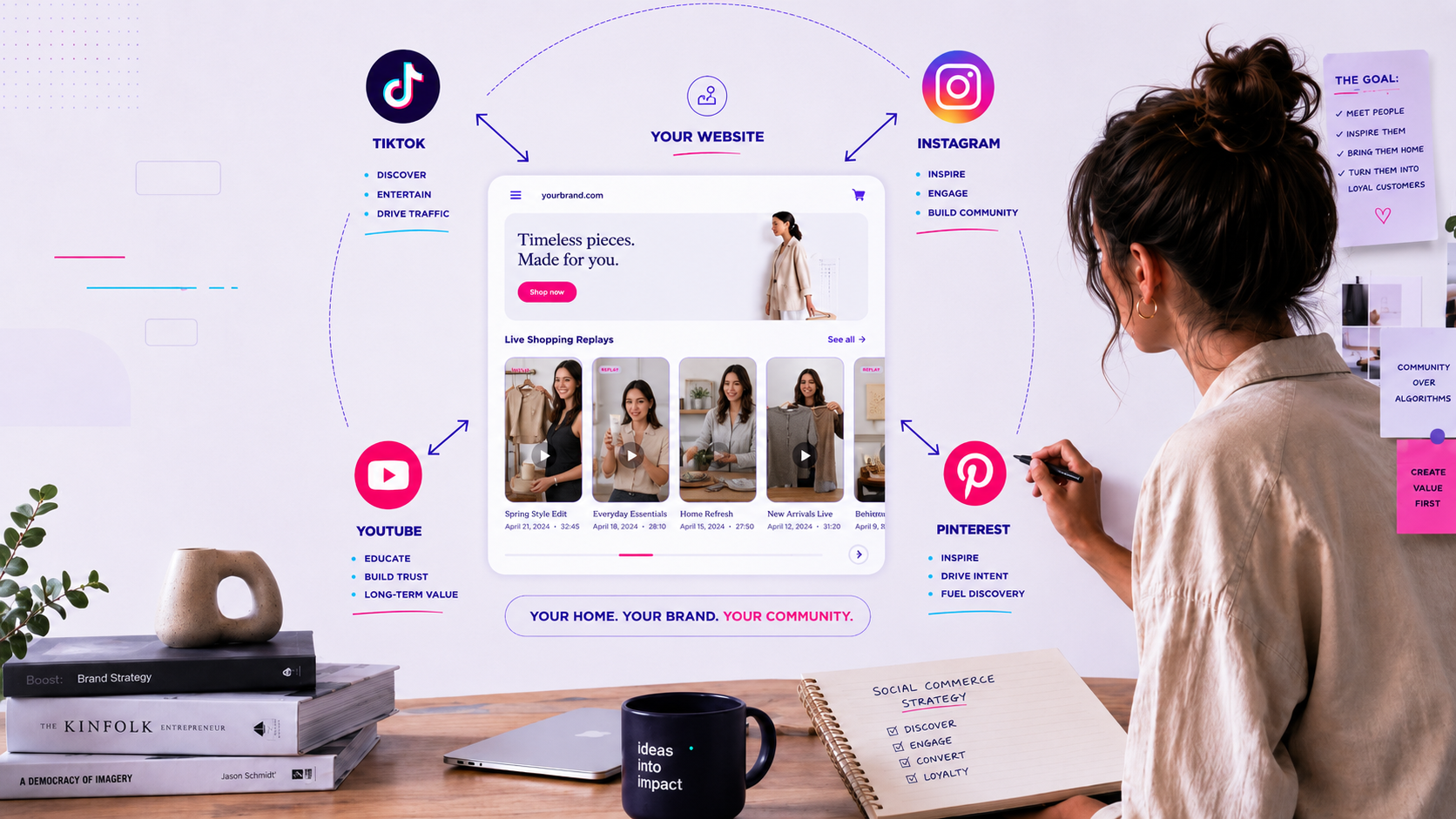
The question brands keep asking is the wrong one
For a couple of years now, the standard social commerce conversation has been: "Which platform should we bet on — Instagram, TikTok, YouTube?" It's the wrong starting question. It puts your strategy's foundation on ground you don't own, and platforms have been changing that ground faster than most brand roadmaps can keep up with.
The better starting question is: what do we own, and what do we rent? Your product pages, your on-site shopping experience, your customer data — that's owned. Your reach on Instagram, TikTok, YouTube, or Pinterest — that's rented, on terms someone else sets and can change without much notice.
This guide starts from the owned side: what a strong on-site social shopping experience actually looks like, and how each major platform is best used to feed and amplify it — rather than treating any one of them as the destination.
Why owned-first, and why now
A few things have made "rent a platform, hope it stays put" a riskier default than it used to be: checkout routing changes on Instagram and Facebook, AI increasingly deciding what gets shown (Meta's automated ad and product matching), experimental discovery features (Pinterest's AI shopping test), and structural uncertainty at major platforms (TikTok Shop's ownership situation).
None of these changes are, on their own, catastrophic. Taken together, they mean that a commerce funnel anchored on any single external platform is exposed to decisions made outside your business — and often announced with little warning. The brands that weather these shifts best are the ones that treat platforms as distribution, not destination.
What an owned experience looks like
An owned-first social commerce experience has four components:
- Shoppable video and UGC on product pages. The same short-form content that performs on social lives natively on your PDPs, driving on-site consideration and conversion.
- A vertical, feed-style on-site browsing experience. The scroll-and-discover pattern people already know from social, reproduced inside your own site — under your control and measurable end-to-end.
- First-party data ownership. Every view, tap, add-to-cart, and purchase is yours to analyze, segment, and act on — not aggregated behind a platform dashboard.
- A single enforcement point for brand and compliance standards. One place where the rules for what goes live under your brand — automated or not — are actually checked.
Platform-by-platform: the amplification role
With the owned experience in place, each major platform plays a distinct, complementary role.
- Instagram — Top-of-funnel and consideration channel; content is highly reusable on product pages.
- TikTok — Best for reach and short-form product demonstration; treat TikTok Shop dependency as higher-risk given ongoing ownership uncertainty.
- YouTube — Longer-form trust-building content; strong as a source of authoritative product context for on-site use.
- Pinterest — High-consideration category discovery; newer AI shopping experiences are experimental and not something to plan a strategy around.
- Meta ad and affiliate tools — Scaling distribution, increasingly AI-automated; requires an explicit decision on how closely to monitor AI-selected product and format choices.
The five-step loop that makes it work
Owned-first doesn't mean turning your back on social. It means running a loop that puts the owned experience at the center:
- Produce content where it performs best — on the platform native to the format.
- Understand what's converting, and where — across platforms and on-site, in one view.
- Repurpose the winning assets into the owned experience — PDPs, on-site feed, email, retail screens.
- Check against brand and compliance standards before anything — AI-assisted or not — goes live under your brand.
- Feed the learnings back into the next round of content.
This is the loop LiSA is built to run: connecting content across channels, analyzing what actually converts, repurposing it into owned experiences, and providing a single checkpoint for brand and compliance standards before publish.
A practical starting checklist
Five questions worth answering honestly before your next planning cycle:
- Do your product pages currently include shoppable video or UGC, or does that content only live on social platforms?
- If your top platform of choice changed its checkout or algorithm tomorrow, how much of your commerce funnel would be disrupted?
- Do you have a single view of which content is converting, across platforms and on-site — or is that data siloed per channel?
- Is there a compliance or brand-consistency check in place before AI-assisted or automated content goes live under your brand?
- Are your best-performing social assets being repurposed on-site, or do they live and die on the platform they were made for?
Where to start
None of this requires abandoning social platforms — they remain the best tools available for reach, discovery, and content production. What it requires is treating your own site as the durable center of your commerce strategy, and every platform as a way to feed and amplify it, rather than the strategy itself.
Curious what this looks like for your brand specifically? Get in touch with LiSA's social commerce team — or subscribe to The Feed, LiSA's monthly newsletter, for a running view of how this space is changing.
Platform details in this space change fast. We keep this guide current, but it's worth double-checking specific platform features against their latest announcements before making major bets.
See how it works.
Explore the product and see how brands publish shoppable video at site speed.
See how it works →Keep reading
All articles →.png)
How TikTok’s Ban Impacts the Retail Industry and Social Commerce Strategy
January 20, 2025 · 3 min read
.png)
Driving Digital Sales: A Guide to Shoppable Content on Social Media and E-Commerce
May 31, 2024 · 11 min read
.png)
Post-Event Boost: Maximizing Your Live Shopping Event
March 15, 2024 · 7 min read